













 suburban housing mid-20th C
the 1940s house
hall
master
suburban housing mid-20th C
the 1940s house
hall
masterbedroom bathroom kitchen
design cooker kitchen
sink kitchen
units larder


The sink, taps and draining board
in British 1940s suburban kitchens
As explained on the page about the mid-20th Century housing estates, the most up-to-date 1940s British suburban semi-detached houses were built in the 1930s. However by the end of the 1940s, with the war over, fitted kitchens with fitted sinks and draining boards were beginning to come in to better off households.
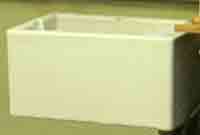
Stoneware sink, common in kitchens and sculleries before the 1950s. The left hand edge of a wooden draining board can just be seen on the right.
For the 1930s and 1940s kitchen, you must imagine the white wall tiles and the basic taps coming out of them.
The sink and draining board that I remember in my parents' 1940s suburban kitchen in Edgware were almost certainly fitted in the late 1930s.
The sink and taps
The design of the sink was like the early 1900s sink of my mother's childhood except that there was a hot as well as a cold tap. Both taps came out from the white tiled wall. I have never seen an identical arrangement in any of the museums I have visited, so there is no accurate photograph.
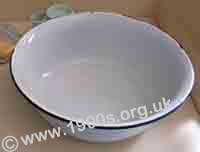
The sink was the standard large white stoneware. (Stoneware is made from a special clay and fired at a very high temperature so that its hardness resembles stone.)
The sink was mounted in position on metal brackets. It held a dishcloth and a white enamel bowl for washing up. On the floor underneath the sink was a space with various other bowls and buckets plus the standard household soap with a carton of washing soda. In many houses, this area was hidden with a short curtain hung on wire, but my mother disliked that arrangement and our area was in full view, U-bend and all.
Both the soap and the soda were used together for washing up.
The draining board
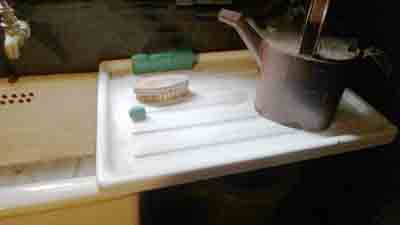
White enamel draining board, mounted against the sink on metal brackets.
The sink had a white enamel draining board attached which I never saw on other housing estates of the same period. There all the draining boards seemed to be wooden. In fact, it took me some years to find an enamel one to photograph. I finally found one in Llanerchaeron House in Wales.
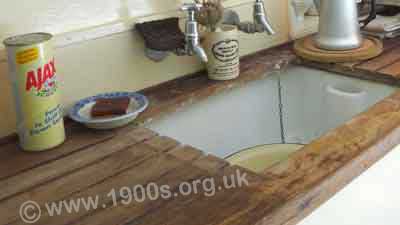
Wooden draining board, photographed in Tilford Rural Life Centre.
Our enamel draining board was mounted on visible metal brackets at the side of the sink.
I always thought how clean our draining board looked compared with the wooden ones. Bare unvarnished wood always looks rather grubby when wet. I suspect that enamel draining boards were more expensive than wooden ones. They did chip, though, which left black marks.
The end of these sinks and draining boards
Years later sink and draining board arrangements were replaced by integral sink units with cupboards underneath. There were no integral sink units in ordinary 1940s houses, in spite of what museums and magazines may imply. I cannot of course speak for better-off households, but since design is led by availability of materials, I doubt it.
Before the mid or late 1950s, the space under our draining board was empty, except for the occasional bucket or bowl. When my mother was persuaded to part with her old mangle for a spin dryer, that was where it went.
If you can add anything to this page or provide a photo, I would be pleased if you would contact me.
Text and images are copyright

