













 the kitchen (cooking) range
the copper water heater/ boiler
the geyser water heater
everyday washing facilities
guest
the kitchen (cooking) range
the copper water heater/ boiler
the geyser water heater
everyday washing facilities
guestwashing facilities care of
teeth shaving equipment bathing facilities gas lighting
in houses gas street lighting the lamplighter


How people washed themselves in the Victorian home
By the webmaster’s mother, 1906-2002
In the early 1900s when I was a child growing up on the working class Victorian housing estate, it was a matter of principle that we - and indeed adults too - were kept clean.
Where we washed
We washed every day in the scullery in a little alcove with a curtain across that provided some privacy.
The 'wash basin' - the scullery sink
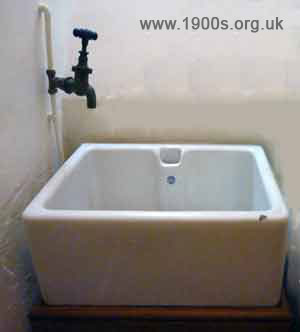
Stoneware sink with a single brass cold water tap above it. Photographed in Fagans Museum of Welsh Life.
The 'wash basin' was the sink that was used for washing up.
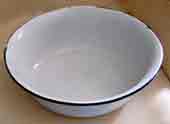
Enamel washing-up bowl. Photographed in Milton Keynes Museum.
It was a large box-like 'glazed stone' affair with a single brass cold-water tap in the wall above it.
Sometimes we used an enamel bowl in it.
The soap
A wooden soap box was also on the wall. No exotic soap ever found its way there. It was always general household soap, usually Sunlight, which invariably had little pieces of grit embedded in where my mother had used it to wash the floor. I don't think our complexions suffered as a result. I was reputed to have had a very good complexion as a child.
So the Sunlight soap did little harm, although I well recall having little patches of dry skin in on my chin in the winter. This was quite common with most children and was treated with Vaseline.
The temperature of the water
We usually washed in cold water, but sometimes as a luxury we had warm water if the copper was lit, or if someone bothered to boil a kettle on the range.
Note from the webmaster
In summer when it was too hot to light a fire, the kettle was probably heated on a primus stove. My cousin who lived with my grandparents in World War Two reports that that was what happened there.
The flannel
Flannels were squares of towelling.
Being washed as a young child
I always remember my great grandmother washing me at the scullery sink. It wasn't a case of just wiping sticky hands. It was a good old wash, and my ears burnt for hours afterwards. Her generation seemed to have a thing about ears. It was always, "Have you washed behind your ears?". It could have been why earache seemed so prevalent in those days. We children always had a twisted corner of the flannel rammed down our ears.
If you can add anything to this page or provide a photo, I would be pleased if you would contact me.
Page based on the recollections and notes of the webmaster's mother (1906-2002) with additional research and editorial work by the webmaster
Text and images are copyright

