














 suburban housing mid-20th C
the 1940s house
hall
master
suburban housing mid-20th C
the 1940s house
hall
masterbedroom bathroom kitchen
design cooker kitchen
sink kitchen
units larder


The 1940s house
As explained on the page about mid-20th century housing estates, the typical 'modern' suburban family home of the 1940s was actually built in the 1930s and furnished with either hand-me-downs or 1930s products. In the first half of the 1940s, though, it wasadapted to meet the needs of war with bomb shelters, windows taped against bomb blast, blackout material, etc., all of which are considered elsewhere on this site.
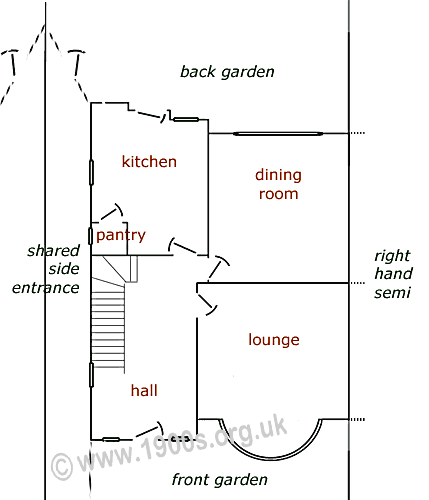
Ground plan of 9 Brook Avenue, Edgware, as it was in the late 1930s and early 1940s, a fairly typical semi-detached house of the period. Scale is approximate.
Typical layout of the 1940s house
Essentially all these houses were in the same general style: two mirror image houses in one building, each described as semi-detached. Sizes of the rooms varied from one estate to another, and some houses had chalet-style roofs which meant smaller loft areas and, in some cases, one less bedroom.
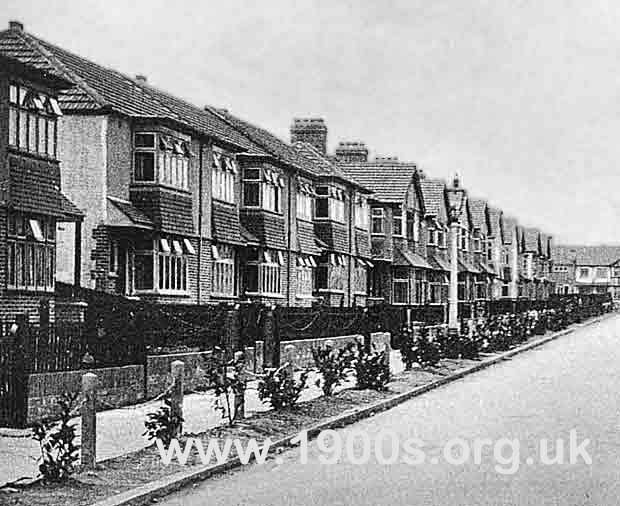
Typical row of 1930s-built semi-detached English suburban houses (Orpington Gardens, N18) photographed in the 1930s and courtesy of Barry Hooper. Note that the houses are in blocks of two which are mirror images of each other, with a side entrance in between.
Click for a larger image
The same houses exist today but there are no verges with shrubs; no gas street lamps; and no iron chains and railings along the verges and in the front gardens. (Chains and railings were removed throughout the country during World War Two to make steel for the war effort.).
Houses on less affluent estates were were in blocks of three or four, the inside ones being described as 'terraced', but they were all of the same general pattern inside.
On some estates the windows were rounded bays; on others they were square bays and some had no bay at all. All the opening windows were of 'door' types with smaller fanlight windows above - a major change from the sash windows of previous times. The frames were wooden which had to be painted every few years.
Insulation and heating
It was not common to have cavity walls. The outside walls of our house were certainly built without a cavity, two bricks thick. So they were not insulated which made the house difficult to heat and drafty in winter.
All the windows were single glazed which added to the downdrafts in winter.
Room arrangement
The arrangement of the downstairs rooms is shown in the first of the two plans.
The front door opened into a hall from which there were stairs to the upper floor, two doors to living rooms and at the end of the hall a door to the kitchen.
Note that there was no downstairs toilet, something which was seen as a necessity in later semis.
On the upper floor was a landing, two bedrooms above the two sitting rooms, a small bedroom above the front part of the hall and a bathroom above the kitchen. Above the upper floor was a sizeable loft with a floor-space equal to that of the upper floor.
The side entrance
A major complaint about these houses was that they shared a side entrance with the house next door. This was in fact a driveway leading to the back garden and back door. Children liked to play ball with their friends in their side entrances which the houses next door found noisy.
Modifications in the 1950s
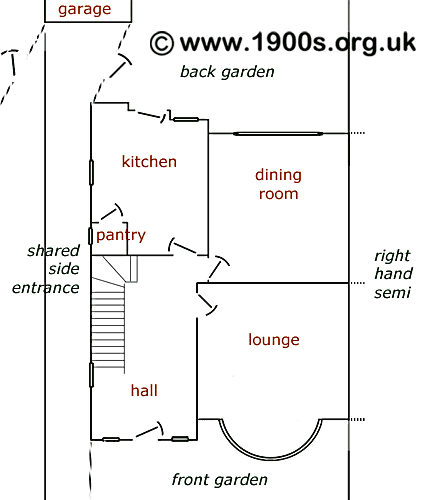
Late 1940s or early 1950s plan showing the common addition of a garage in the back garden, with access along the shared side entrance.
After World War Two when cars started coming back on the roads, the shared side entrances caused another annoyance. The side entrances were wide enough to take a car but of course only half the width belonged to each house. So if one household's car was left off the road in a side entrance, the other household complained. This led to garages being built in back gardens, with the side entrances being used merely as shared drive-ways. The gardens were small and the garages did rather dominate. Ours was a cheap asbestos affair which my mother camouflaged with runner beans and then, later when austerity bit less, with climbing flowering plants.
Home ownership and costs
A feature of these 1930s/1940s houses, compared with the earlier Victorian terraced houses was that they were typically owned by the occupants rather than rented. (There must have been exceptions, but this was the general rule.)
My grandparents apparently warned my father that he was taking on too much by going for home ownership. They pointed out that he was tying himself to some 20 or more years of mortgage repayments and that anything that went wrong in the house would have to be paid for out of his own pocket. It did not deter him - but see the cost of a 1930s house.
Fortunately the building society in Edgware, and probably all building societies elsewhere in the country, suspended requirements for mortgage repayments during the war. This was crucially important as men away in the forces would not have been able to afford the repayments.
Text and images are copyright

