













 suburban housing mid-20th C
the 1940s house
hall
master
suburban housing mid-20th C
the 1940s house
hall
masterbedroom bathroom kitchen
design cooker kitchen
sink kitchen
units larder


The larder/pantry
in the British 1940s suburban house
As explained on the page about the mid-20th Century housing estates, the most up-to-date 1940s English suburban semi-detached houses were built in the 1930s.
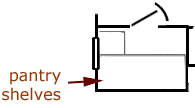
Plan of the walk-in pantry/larder of a 1940s semi-detached suburban house. Most similar suburban houses had smaller kitchens with a cupboard instead of a walk-in pantry.
See the 1940s kitchen for how this plan fits into the plan of the kitchen.
Although all the estates of these suburban houses houses had the same basic plan, our estate was fortunate in that the kitchens were larger than most and had small walk-in larders. We always called ours the 'pantry'.
Design of the larder/pantry
The pantry had shelves, walls and window sill tiled in white like the kitchen walls.
As a hangover from the old outdoor meat safes, the window had a fanlight which was normally kept open which was covered with wire mesh to keep out flies.
The door of the pantry was self-closing which must have been useful with flies around. However many a small visiting child was trapped inside while playing. It was always the first place to look when a child went missing.
The contents of the pantry
The top shelf was used for storing tinned food and other non-perishables. It was quite high and we needed a chair to get to it. The middle shelf was at eye level and was used for perishables such as milk and butter. There were no fridges, remember.
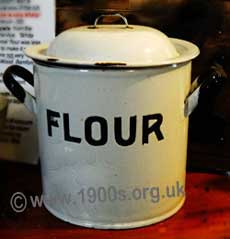
Enamel flour bin, typical of those used before the 1950s. Photographed at the Usk Museum.
Note the rust where the enamel has chipped.
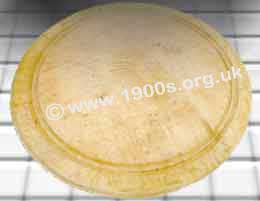
Whitewood breadboard, photographed at a car boot sale. Ours was just like this. There was no slot for the bread knife which was kept in the knife box.
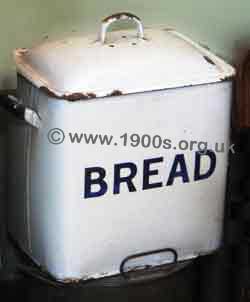
Enamel bread bin, typical of those used before the 1950s. Photographed in the York Museum. Ours was just like this but the enamel was green.
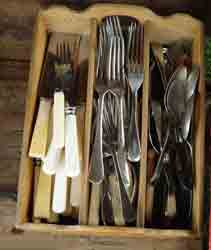
Whitewood cutlery box, photographed at a car boot sale.
On the lower middle shelf was the breadboard and the cutlery box. Both were made of white untreated wood, known as whitewood, and, along with our whitewood kitchen table, were scrubbed regularly with a scrubbing brush and household soap from a galvanised bucket of hot water.
Under the shelves and around the floor were stored the large enamelled bins for flour and bread.
My mother also kept the scales on the floor. They were large, of the balance style, with their own set of iron weights. As the weights were far too heavy for use in general cooking, she relied on volumes: A quarter of a half-pound pack of margarine was 2 ounces; a rounded tablespoon of flour was 1 ounce; a rounded dessert-spoon of sugar was 1 ounce, etc.
Lesser used pots and pans were piled behind the bins.
If you can add anything to this page or provide a photo, I would be pleased if you would contact me.

