














 the weekly wash early 20th century
the mangle early 20th century
drying the wash early-mid 20th C
ironing early 20th century
the bagwash mid 20th century
the laundrette mid 20th century
twin tub wash machines mid 20th century
the Flatley dryer
the weekly wash early 20th century
the mangle early 20th century
drying the wash early-mid 20th C
ironing early 20th century
the bagwash mid 20th century
the laundrette mid 20th century
twin tub wash machines mid 20th century
the Flatley dryer


The mangle, used in the past to squeeze water from wet laundry
By the webmaster's mother, 1906-2002
Mangles and wringers: what they were used for
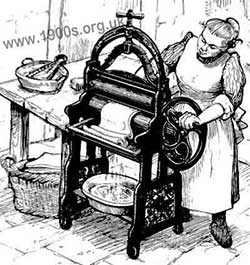
Sketch of a woman mangling
Before the arrival of spin dryers around the 1950s, all but the very poorest of households had a mangle. It was used on washday to remove the majority of the water from the wash after each rinse.
(A widely used word nowadays is 'wringer' which is surprising because 'wringing' means twisting, and no twisting is involved in mangling. Mangle was the only word used in Britain in the past.)
How mangles worked
The mangle was a heavy mechanical contraption about four or five feet high with a handle that turned two rollers. Wet items were fed through the rollers which squeezed out the water into a large bowl or tin bath underneath.
There was a screw on top of the mangle to adjust the distance between the rollers according to the thickness of the fabric. For blankets, for example, the screw was let out as far as possible.
The legs of the mangle were on wheels which could be clamped when the mangle was in use.
Storing the mangle
As the mangle was so large and took up so much room, it was kept outside the back door with a sheet of tarpaulin over it to protect it from the weather. This was usual practice in the Victorian terraces where I grew up in the early 1900s.
(Later when I was married, mangles were smaller and mine fitted into the kitchen of my 1930s/1940s house.)
How the mangling was done
On washdays in good weather the mangling could be done outside where the mangle stood, but in bad weather it had to be rolled indoors.
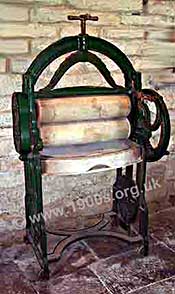
Old Victorian or Edwardian mangle for removing water from wet laundry.
After each rinse, every single item of the washing had to be put through the mangle. Each one was placed between the rollers and as the handle was turned, the rollers rolled and fed the item through. The water dropped into the bowl or tin bath below. It was hard work turning the handle and every item was rinsed several times.
Small clothes like socks could go through the rollers as they were, but larger items had to be folded into strips which were narrow enough to go through the rollers. For sheets and blankets this folding was a two-person job, with one person at each end of the sheet or blanket, and care had to be taken to keep it off the floor. If no-one was available to help, the pegs on the clothes line could sometimes replace the second person.
When my brothers and I came home from school for our mid-day meal, mangling was still in progress on washdays. A lot of energy was needed for it, and I had to help by holding the sheets as straight as I could while my mother turned the handle of the mangle. It was by no means unusual for children to get their fingers caught in the rollers.
When items had gone through the rollers, they almost looked as if they had been ironed already, but they were still quite damp and needed to be dried and irons. Drying the wash and ironing are on separate pages.
Mangle damage to buttons
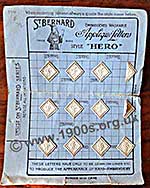
Card of square linen buttons as bought from a shop.
These buttons would pass safely through the rollers of a mangle.
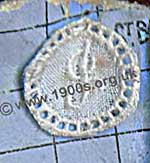
A round linen button which would pass safely through the rollers of a mangle.
Both courtesy of Di Duck
Broken buttons on clothes
Note from the webmaster
In the 1940s, while I was growing up, it was not unusual to see people with broken buttons, almost certainly because someone had risked using the mangle on them.
Perhaps it was understandable that women risked using the mangle on buttons, rather than having to wring the water out by hand, but then the buttons invariably chipped under the pressure of the rollers, even with the top adjustment loosened.
Mangle-friendly buttons: linen buttons and shank buttons
So buttons on clothes that were often washed, particularly on men's shirts, were made of woven linen so that they wouldn't break under the pressure of the mangle rollers.
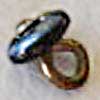
Shank button for thick fabrics, which was removed for washing
Clothes like heavy overalls needed heavier buttons. The solution was to have buttons with metal shanks which. Rather than being sewn in place, they were poked through small holes and held in place with studs or clips. The clips were rather like short hair grips.
Then every time that the item was washed, the buttons were removed and then clipped back into place afterwards. The holes for the shanks were sewn just like regular button holes except that they were much smaller and round.
Once spin dryers came on the market, types of button ceased to be a problem.
Text and images are copyright
If you can add anything to this page or provide a photo, I would be pleased if you would contact me.
Page based on the recollections and notes of the webmaster's mother (1906-2002) with additional research and editorial work by the webmaster

