














 the
thefood safe food
coolers cooking pots
and
kettles the Sunday roast early 20th C weekly menus early 20th century everyday meals early 20th C food in poor families early 20th C better taste
in
the past? Granny's dripping Granny's
roast
potatoes Granny's gravy Granny's
roast trimmings Granny's bubble and squeak


The food safe / meat safe before home fridges
By the webmaster’s mother, 1906-2002
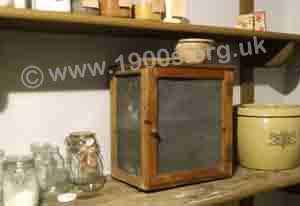
A food safe for a normal sized family. The jars beside the safe indicate its size.
Before fridges came into ordinary homes, every household had what was known as a food safe, also known as a meat safe for storing perishable items.
What a food safe/meat safe was like
A food safe was a wooden cupboard with doors and sides open to the air apart from a covering of fine galvanised wire mesh. This allowed the air to circulate while keeping insects out. There was usually an upper and a lower compartment, normally lined with what was known as American cloth, a fabric with a glazed or varnished wipe-clean surface.
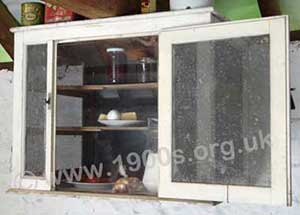
A large open food safe on a shelf. Photographed at Tilford Rural Life Centre.
Food safes were fairly small because they were primarily for rapidly perishable foods like meat, milk, butter and eggs. However one of the photos does show an extra-large one with three shelves.
Positions for food safes
Food safes were always placed where it was cool and draughty.
For ordinary households like those where my mother lived on the Huxley Estate, this was in the passage just outside the scullery door against the fence that was shared with the neighbour. Consequently the safes were in the shade of one or other of the houses for almost all of the day, and access was easy. Where possible, safes were at eye level, either on stilts or attached to fence posts.
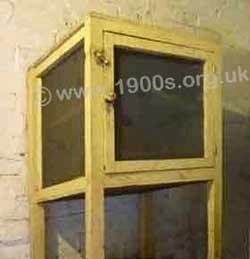
Food safe on stilts, of the sort kept in an outside passage in the shade.
In larger houses safes were often on shelves in cool, shaded rooms.
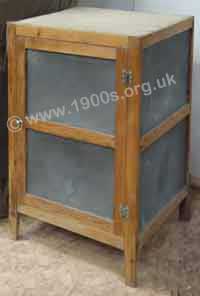
Later on, into the 1930s, when the layout of new houses did not lend itself to placing safes outside, there was often a built-in cool, tiled pantry or larder with a meshed window. If not, a shelf or standing room for a food safe had to be found somewhere.
If you can add anything to this page or provide a photo, I would be pleased if you would contact me.

