














 coal
coalfires gas
fires electric
fires paraffin heaters boilers for hot water hot water bottles frozen
up ironing equipment baking equipment misc kitchen tools kettles misc electric equipment fuses and fuse boxes


When the coal-fired boiler supplied hot water and kitchen heating
The coal fired boiler
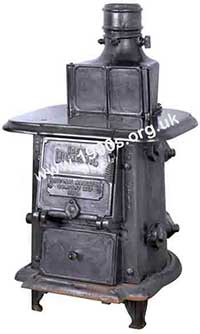
A 1930s boiler, coal fired. Photo courtesy of Customer Services, Ideal Heating.
The living area of a 'modern' 1930s and 1940s house was the kitchen, and it contained a coal-fired 'boiler' which heated water. The hot water was sent through a pipe into the hot-water tank in the airing cupboard which supplied the hot taps in the kitchen and bathroom. A second pipe returned the water to the boiler for reheating.
Every kitchen I saw in the 1940s seemed to have such a boiler, which was a more modern, plumbed in version of the 'copper' of earlier times. Even older properties seemed to have discarded their coppers for these boilers (just as they had discarded their kitchen ranges for gas or electric ovens). These boilers were still giving good service into the 1950s and later.
Models of boiler
There were a number of models of these boilers. The early 1930s model in the first picture, supplied for this website by Ideal Heating, was similar but not identical to the one I grew up with in the 1940s. Whereas the one in that photo is clearly cast iron like the old kitchen ranges, ours was 'stove enamelled' in a mottled pale grey colour like the one in the second photo. (Stove enamel is a heatproof enamel.) However, ours was not quite the version of either photo.
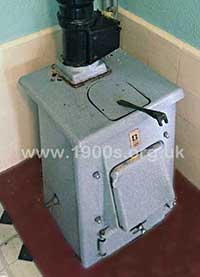
Boiler with a stove enamel finish showing the lid with its lever type detached handle. The boiler of our lid, though, was round, as can just be seen in the top photo. This photo is courtesy of John Lewis.
How the boiler was loaded and cleared of ash
All versions of the boiler had a lid at the top for the coal to go in. Because the boiler got so hot, the lid was lifted with a detachable handle kept separately. It worked like a lever with a kink at one end which fitted into a hollow suitably placed in the lid.
Our boiler was very much like the one in the second photo, but the lid was round, which meant that the handle could be placed to suit either left or right handed people. Ours was kept for right handed people and moved further round than in the photo so that it didn't catch when walking past.
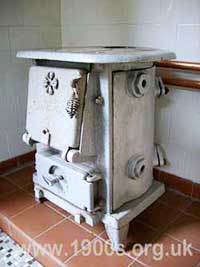
A 1933 boiler, coal fired showing a stove enamel finish. Photo courtesy of Steve James.
The door in the middle hinged down to create a flat surface showing the red hot coals held in place with a grill. This surface could be used for heating irons for ironing, although we never used it for that purpose as we had an electric iron.
The door at the bottom was for removing the ash and spent cinders.
The fuel for the boiler
The 'coal' for the boiler had to be a special type which my mother just called 'boiler fuel'. One type, called Phurnicite, looked as if it had been made out of particles, compressed into uniform nuggets. The other type, called Anthracite, looked like small pieces of ordinary coal but it burnt hotter. Both types came in lumps which were small enough to go through the lid of the boiler.
The Phurnicite, Anthracite and regular coal for our coal fires were delivered by a coalman from the local coal yard.
Rooms heated by the boiler
Apart from heating water, the boiler itself also gave out a great deal of heat. So the kitchen was a warm and cosy living area. In the winter, we seldom moved out of it in the early 1940s when my father was away in the army.
The bathroom was also warm because it was directly above the kitchen. It contained the airing cupboard which housed the hot tank and added to the warmth.
The coal bunker for storing the boiler fuel and coal
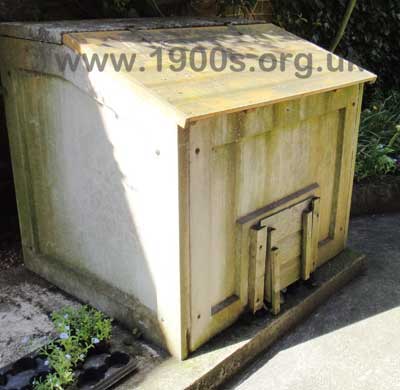
A concrete coal bunker
Our boiler fuel and coal were kept in what was called a coal bunker and was outside the back door. Unlike the one in the picture, it was a home-made brick built container large enough to hold a winter's worth of sack loads with rectangular holes at the bottom for coal shovels to get into. It had a brick partition to keep the boiler fuel separate from the coal for the coal fires, and was covered loosely with corrugated iron which was removed when a delivery was due. It was just under shoulder height, so that the coalman could most easily tip his sack into it.
If you can add anything to this page or provide a photo, I would be pleased if you would contact me.
Text and images are copyright

