














 coal
coalfires gas
fires electric
fires paraffin heaters boilers for hot water hot water bottles frozen
up ironing equipment baking equipment misc kitchen tools kettles misc electric equipment fuses and fuse boxes


Fuses blowing electrical equipment, pre-1950s Britain
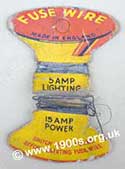
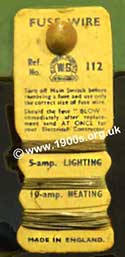
Examples of fuse wire, as sold in shops: 5 amp for lighting and thicker 15 amp for heating.
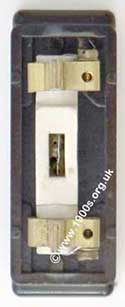
Holder for a fuse wire, enhanced to show the fuse wire through the glass window. This window was to show whether or not the fuse had melted
In the 1940s and into the 1950s when I was growing up, power cuts, common as they were, were not the only reason why electrical equipment suddenly stopped working. The other reason was that a fuse had blown. These fuses were not inside the electric plug attached to the equipment, as in later years. They were in a central fuse box - see below. There were no fuses in the old plugs.
Fuses
A fuse was a short length of wire with a fairly low melting point such that it melted when a current surge became too great. This broke the circuit so that everything plugged into that circuit suddenly stopped working.
The fuse holder
There were different designs for holding the fuses inside the fuse box. The part that held the fuse wire was ceramic with a narrow window to show at a glance whether the fuse had melted. The containing box was probably Bakelite.
One that has survived in our junk box is shown in the photo.
The fuse box
All the fuses for a house were in a box called a fuse box which was situated where the electric power came into the house. Ours was in the cupboard under the stairs in the hall. There was one fuse for each circuit and there were probably several sockets on any one circuit.
Replacing a fuse
When a fuse blew, it had to be replaced. Hardware shops sold fuse wire in various thicknesses to guard against different sizes of power surge.
A pack of fuse wire was always kept ready for use on top of the fuse box.
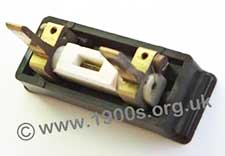
Another view of the fuse holder which better shows its structure.
Why fuses blew
Of course fuses blew to protect against surges from faulty equipment. They also blew if too many pieces of electrical equipment were turned on in the same circuit.
If a fuse kept blowing, it meant that something more serious was wrong with a piece of equipment on that circuit or that a piece of equipment needed to be moved to another less-used circuit.
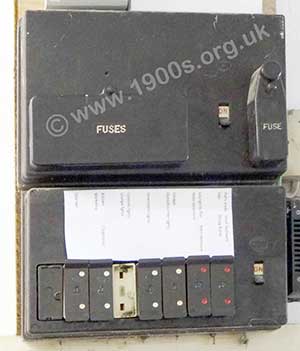
A fuse box. Note the labelling to indicate which fuse protects which part of the house. One fuse holder has been removed to show how the fuse holders plug into the box.
Why fuses blew when equipment was first turned on
Guest contribution
When motors were first turned on, they tended to take a larger current than when they were running. So that was when fuses would go blow. As young boys, my friend and I used to turn on our motor without its belt on, so that the load was less and it took less current. Then the fuse didn't blow. When the motor was fully up and running, we would put the belt back. Not to be recommended!
Neil Cryer
Fuses inside plugs
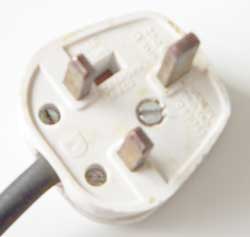
13 amp plug wired onto a cable.
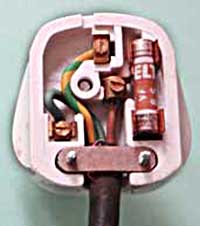
Inside a 13 amp plug showing its wiring
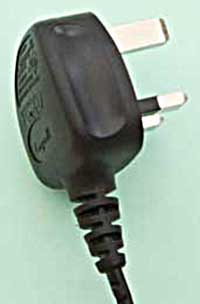
Newer 13 amp plug with cable and plug moulded together
In the 1950s, there was a regulation that every piece of equipment must have a plug with its own fuse. The plugs were called 13 amp plugs, although they were often fitted with fuses of other sizes, depending on the power rating of the equipment.
For some years, electrical equipment had been sold without a plug. So plugs had to be bought separately. A rough and ready check for someone's general competence was whether they could 'wire up a plug' with the correct coloured wires going to the correct contacts and with the correct fuse.
Later on, much equipment was sold with its cable moulded onto the appropriately wired plug.
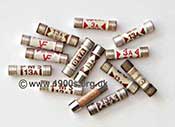
A collection of 13 amp and 3 amp fuses for use inside a plug
Text and images are copyright

