














 the kitchen (cooking) range
the copper water heater/ boiler
the geyser water heater
everyday washing facilities
guest
the kitchen (cooking) range
the copper water heater/ boiler
the geyser water heater
everyday washing facilities
guestwashing facilities care of
teeth shaving equipment bathing facilities gas lighting
in houses gas street lighting the lamplighter


How men shaved with open razors
By the webmaster’s mother, 1906-2002
In the early 1900s when I was a child, my father kept his shaving equipment in the sink alcove in the scullery.
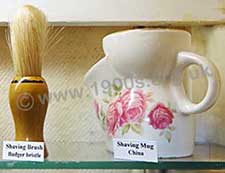
A man's shaving mug and brush
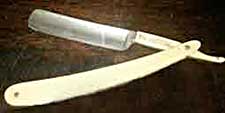
An 'open' man's shaving razor: a very sharp blade which folded inside a handle
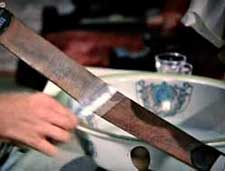
Razor being sharpened on a leather strap known as a strop
Shaving equipment
The shaving equipment consisted of a shaving brush, a specially shaped china shaving mug and a razor.
The shaving mug held the hot water and the lip of the mug held the soap.
The open 'cut-throat' razor
Shaving could be a tricky business because the razor had an open blade which had to be kept very sharp. When it wasn't in use, it folder inside its handle, as shown in the photograph, but it could still needed to be treated with care.
How the razor was sharpened
The blade was sharpened on a special leather strap called a 'strop'. This had a fine powder applied to it to act as an abrasive. Both sides of the blade had to be stropped.
The process of shaving
My father would use the brush and soap to work up a thick lather around his chin and then contort his face and use his hand to stretch his skin.
Then, as he drew the blade of the razor over it, only the stubble would be cut and not his face. It was, though, quite common to see men with cuts on their faces from shaving.
From open razors to safety razors
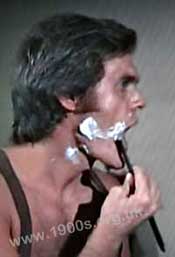
Shaving with an open razor
Guest contribution
Safety razors were definitely safer than the old, open, cut-throad type, but they had their own problems when they first came onto the market. The blades were made of carbon steel as in the Thin Gillette, Blue Gillette and 7 O'Clock brands. They needed to be rinsed and dried between uses which usually needed the razor to be opened up, the blade extracted, rinsed, dried and replaced - rather a rigmarole! My father's and grandfather's razors even needed to be unscrewed to achieve this.
Malcolm Keen
If you can add anything to this page or provide a photo, I would be pleased if you would contact me.
Page based on the recollections and notes of the webmaster's mother (1906-2002) with additional research and editorial work by the webmaster. Photos by the webmaster with acknowledgments to West Somerset Rural Life Museum and Fagans Museum of Welsh Life
Text and images are copyright

