












 a suburban primary
school classrooms free school milk absenteeism from
school teachers' favourites the 11-plus exam May Day at school


Free school milk:
children's experiences
Why free school milk
Free school milk was the result of several acts of parliament to ensure that children from poor families and, more generally, children growing up with the rationng and shortages of World War Two should be adequately nourished. Not that I knew anything of this at the time. So this page starts with my own experiences of receiving free school milk as a child in my primary school in the 1940s.
The delivery of school milk
Guest contribution
In freezing weather our milk crates often arrived frozen. So they were kept by a radiator in our classroom to warm up.
Lyndsey Hogg
The milk was delivered during the first part of the morning in good time for the morning break, or playtime as it was called. As all the children were in class at the time, I never saw the actual delivery, but it must have been either in milk churns or in crates as described on the milk delivery page.
The management of free school milk in the 1940s
The management of the milk at my school in the 1940s left much to be desired.
Just before we went out to play we had to queue up at a table of china beakers. It was the caretaker's job to set these out and to wash them afterwards. Her washing up technique left much to be desired.
What I particularly remember was that the beakers were her job was to have washed up and that they always stunk of sour milk. We were supposed to pick up a beaker and take it to her for her to pour milk into it. I always tried to find one that didn't smell - but so did all the children. The caretaker would see the children smelling the mugs, get very cross and demand that we shouldn't be so fussy.
The caretaker's name was Mrs Milner, and she lived in what looked to me as a very nice house at the back of the Reception. I suppose there must have been a Mr Milner although I don't remember him. Mrs Milner, like most women of her age, was large, as if she had had many children, and she was always sour and bad tempered. Maybe she had good reason to be: it was wartime and who knows who she had lost in her family.
As far as I know, we never came to any harm from the stale milk deposits.
The management of free school milk in later years
Much later, the milk arrived in crates of small third of a pint glass bottles and the children drank directly from them using waxed paper drinking straws - much cleaner and pleasanter. I suppose that Mrs Milner must have had the task of rinsing out the bottles for collection and throwing away the straws and bottle tops, but that wasn't our concern.
These third of a pint milk bottles were never available in shops.
The bottle tops of the school milk
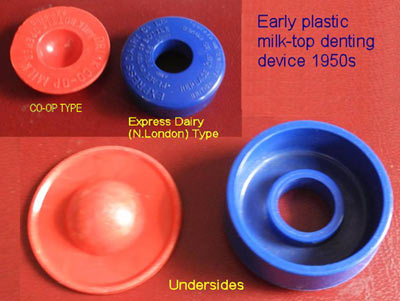
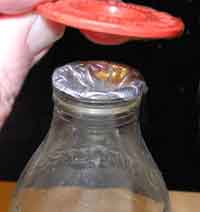
Laurie Prior describes how the foil tops of school milk were removed efficiently. This was in the 1950s once plastic had arrived.
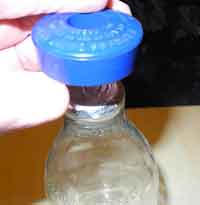
Denter tools for opening foil topped school milk bottles
 |
 |
 |
Laurie Prior
Some dairies closed the tops of school milk bottles with waxed cardboard disks. Laurie Prior gives more details.
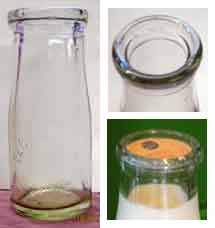
Left and top right: two views of a 1/3 pint school milk bottle of the sort that had waxed cardboard tops. Bottom right a mock-up of the top in place photographed at a Watercress Line event.
Whereas the bottles for foil tops needed to have a rim on the outside so that the foil could grip under it, bottles for wax discs had to have a rim on the inside to support the disc. These bottles for disc tops also seem to have had a wider top than those I remember for foil tops.
The discs had a hole half punched into them so that a straw could easily be poked through.
The milk arrived in crates. In classes such as ours one pupil was given task of 'milk monitor' and halfway through the lesson he or she would use a denter tool like one in the photo and squidge all the tops in the two crates. This provided a total of 50 bottles of open milk.
A straw would be popped into each bottle by another 'helper' (rather unhygienic back in those days) but at least the denter avoided having the risk of over-zealous pupils stuffing their thumbs into the milk causing a milk fountain all over clothing and the crate. The denter worked well and very quickly and was supplied by the dairy.
Laurie Prior
How we made children's pom-poms from the milk top discs
Guest contribution
Our teacher used to save the milk top discs, wash them, then with two held together we used to get a needle and salvaged wool from a big sack, then thread the wool through the hole and round the outer edge and back through the centre till the hole was full with lots of different colours. The teacher would then cut the wool all round the outer edge with the scissors between the two discs, then wind a strong thread between the discs creating a woolly ball. These were then threaded on a long string and hung across the front of a baby's pram hood as a distraction toy.
Doug Beales
The end of free school milk
In 1968 Edward Short, the Labour Secretary of State for Education and Science, withdrew free milk from secondary schools. His successor, Conservative Margaret Thatcher withdrew free school milk from children over seven in 1971. She is still denounced as a 'milk snatcher'. I am uncertain of the position now for the youngest and poorest of school children. If you know, please let me know.
If you can add anything to this page or provide a photo, I would be pleased if you would contact me.
Text and images are copyright

