














 a suburban primary
school classrooms free school milk absenteeism from
school teachers' favourites the 11-plus exam May Day at school


A suburban primary (infant & junior) school
in 1940s England
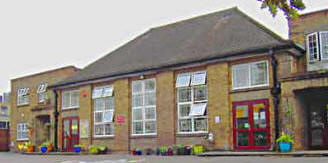
A 21st century photograph of what was Edgware Primary School, courtesy of Tony Woods.
My first school was typical of those built in the 1930s to serve the children in the new suburban housing estates that were going up. The school was Edgware Primary School, and as its name implies it was in Edgware, Middlesex, north London - now Edgware Infant and Nursery School. 'Primary' was the term used for 'infants and juniors'.
I started just before I was five in 1944 while the Second World War was still raging, and I left at 11 for my grammar school.
The headmaster was Mr Bird.
The site
If you can add anything to this page or provide a photo, I would be pleased if you would contact me.
The site was a large field backing onto the Edgware Road. The main playground was in the front, directly onto the Edgwarde Road, which by today's standards seems rather strange because anyone could come in and interact with the children in whatever means they chose. As far as I know, there was no untoward activity.
While I was there the field was still unmade-up and uneven, and was only used for the underground Anderson shelters during the WW2 air-raids.
Access to the school
Access was either from the Edgware Road, through the main playground or via a long pedestrian side alley from Station Road. This alley also led to the local secondary modern school for children who had left the primary school but had not passed the 11-plus exam for a grammar school. That site is now a Sainsbury's supermarket.
I don't remember any facilities for parking cars which says a lot for the state of the traffic at the time. Children and staff either walked to school or used a bus. It never occurred to anyone that it might be dangerous. I suppose there was some safety in numbers, and there was certainly almost no traffic around then because there was petrol rationing due to wartime and post-war austerity.
The school building
The building was quite small. As you went in from the main playground there were cloakrooms on the left. On the right was the school hall which struck me, as a young child, as enormous. Seating was on the floor, although there were chairs at the side for the staff.
Further back towards the open were the classrooms which were reached from a corridor open to the elemants on one side, and on its left was an open grassy area which was used for class photographs. Further on was the headmaster's room.
There were more classrooms upstairs and presumably the staff room and storage facilities, but I don't remember much about them.
The school lavatories
The lavatories deserve a special mention. What stands out in my memory is their floors. They, like other loos of the time, were of a stone-like composite, particles of which glistened in the light. I used to try to get to one of the 'sparklers' to pick it up, but by the time I reached it, the light was no longer on it and it had turned to dull grey stone. The lavatories themselves were low, and they flushed with a pull-chain - so things in the 1940s had improved since my mother's experience of school lavatories in the early 1900s!
Text and images are copyright

