













 the
thefood safe food
coolers cooking pots
and
kettles the Sunday roast early 20th C weekly menus early 20th century everyday meals early 20th C food in poor families early 20th C better taste
in
the past? Granny's dripping Granny's
roast
potatoes Granny's gravy Granny's
roast trimmings Granny's bubble and squeak


How to make dripping taste rich
and wholesome like Granny’s
Based on watching my older family cook in my childhood
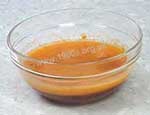
Dripping features in the preparation of almost all the savoury meals with that good old fashioned taste.
Dripping has a wonderful flavour that no amount of herbs, spices or stock cubes can emulate. It is perfect for frying meat and vegetables and for adding flavour to cooked dishes. In times gone by it was a staple meal for children, spread on bread. It is sad that few children of today have ever sampled 'bread and dripping'.
What dripping is
Dripping is the fat that oozes out of roasted meat or poultry once it has cooled and solidified. While the fat is still liquid it is described as 'rendered fat'. Only once it has solidified does it become 'dripping'.
Before battery chickens and imported lamb became commonplace, beef dripping was effectively the only dripping. This was because families traditionally had a large joint of roast beef every Sunday, and other meats were reserved for celebrations such as Christmas.
Beef dripping was regarded as the best tasting of all the drippings, and I agree. Even as late as the 1950s and 1960s, beef dripping was regarded as a delicacy.
How to source fat for dripping today
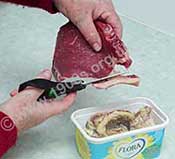
Making off-cuts for dripping by cutting excess fat of braising steak.
Off-cuts can similarly be made from ham, braising steak, lamb chops and pork joints, etc. Note the use of kitchen scissors rather than a knife.
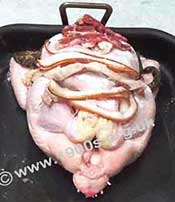
Fatty off-cuts spread on meat before roasting.
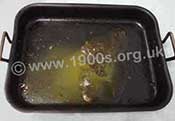
Dirty roasting pan after a roast meal.
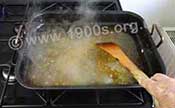
Stirring fat and water in roasting pan to clarify the fat and clean the pan. The flat-ended spatula is essential for this.
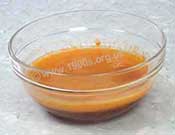
Rendered clarified fat with clarifying water
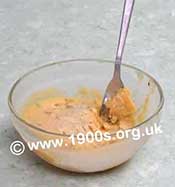
Frozen dripping being gorged out with a fork.
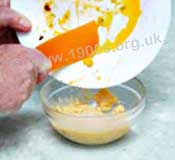
Fat left on a serving plate being added to dripping. The fat in this picture is from lasagna which explains the orange colour which is from tomato.
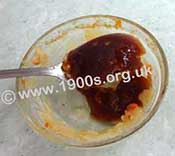
Meat jelly from under the dripping.
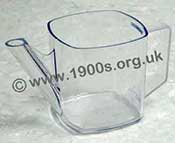
Gravy separator which can also be used for separating rendered fat from meat jelly or clarifying water.
Over the years farmed animals have been bred to be as lean as possible. So roast meals do not produce as much dripping as they did in days gone by - and today's roast meals are more often made with poultry or meats other than fatty beef.
Furthermore the large supermarkets tell me that they are no longer allowed to sell their own off-cuts of beef or fat.
So unless you know your own friendly family butcher you will have to make your own fatty off-cuts from whatever meats are to hand.
I make my off-cuts by trimming off the fatty bits of the likes of ham, braising steak, lamb chops and pork joints, etc which would otherwise be left uneaten on people's plates. Usually I do this before cooking but within the family I have been known to use the better looking leftovers from plates.
How dripping used to be made in ordinary households
Dripping was simply made by pouring the hot fat left in the roasting pan into a heatproof glazed china basin, covering it to keep out flies and dust and leaving it to cool. It was then stored in the food safe.
Any dirty bits of charred meat always sunk to the bottom of the basin and were dug out or straped off and thrown away. Alternatively the rendered fat was 'clarified' by pouring boiling water into it. The water sunk to the bottom of the basin taking the charred bits with it.
How to make dripping the easy way today
It is easiest to prepare the off-cuts using kitchen scissors rather than a kitchen knife. I build up a store of them in the freezer which keeps them fresh.
I use my off-cuts as required, straight from the freezer by placing them over the raw meat for the next roast. It isn't necessary to thaw them before use, as they thaw very quickly in the oven. This renders them down into liquid fat in the cooking pan as well as crisping the outside of the joint.
This use of off-cuts replaces the foil covering which is usually recommended.
Clarifying and storing today's dripping
Dripping made this way can have tiny charred pieces of meat in it. To remove them, the dripping has to be 'clarified'.
I like to do the first stage of clarifying the rendered fat while it is still in the pan because it helps to clean the pan while also preventing wastage.
Once the meat has been removed (and after enjoying the meal with my family) I pour boiling water onto the messy fatty remains and heat both together on the hob. As the water boils, I stir by scraping the bottom of the pan with a flat wooden spatula. This goes a long way towards cleaning the pan for the eventual washing up while loosening as much as possible of the remains of the cooking.
Heatproof dishes have come a long way since the popularity of glazed china basins in my mother's and grandmother's time. So rather than using a china basin for the rendered fat, I prefer to use a heatproof glass basin. This allows me to see how much dripping has been produced, how dirty it is and whether extra boiling water is required for clarifying.
So I pour the contents of the pan into the basin, add more boiling water if necessary, I put on a lid and leave to cool. During this time, the water and charred bits slowly sink to the bottom of the basin, leaving the clean clarified fat on top. Then the basin and its contents either go into the fridge for immediate use or, more usually, into the freezer for later use.
I use the frozen dripping mainly for basting roast potatoes, parsnips and sweet potatoes. For such cooking purposes the frozen dripping can be used straight from the freezer, although beef dripping for 'bread and dripping' needs to be softened at room temperature first.
I find that a fork is the best tool for gouging out lumps of hard frozen dripping.
Bulking out the dripping
I bulk out my dripping from any other sources of meat fat that get rendered during cooking, for example mince and sausages. These would otherwise get thrown away, but I put them straight into the dripping container in the freezer.
Never, though, from anything fishy. Fishy fat is unpalatable.
What to do with the water from clarification
What seems like water at the bottom of the basin can turn out to be nutritious and flavoursome meat jelly which can be added to sources and gravies. However, you can't tell whether this has happened until the fat and water have solidified in the fridge or freezer.
So in general I don't pour off the water/jelly immediately but freeze the dripping with its water/jelly still in it. If the 'water' turns out to be floppy jelly, I scrape it clean of its bits and use it in gravy or stews. If it is just dirty ice, I simply throw it away.
As an alternative, the still hot water at the bottom of the basin of hot clarified fat can be poured away before storing if the container is a special one known as a 'gravy separator'. Its spout is at the bottom of the jug rather than the top, so that tilting pours out the water rather than the floating fat. I seldom bother with these containers for two reasons. One is that the charred pieces of meat tend to get stuck in the spout and the other is that storing what has been poured off in case it turns into meat jelly just adds to washing up.
Why home-made dripping has gone out of fashion
Dripping has gone out of fashion for several reasons, in particular:
- Dripping comes from roasted meat which people hesitate to cook
because of the fatty mess that is left behind. This is tiresome to clean
up and most of it goes down the sink and builds up pipe blockage.
Yet if the fat is used for dripping as explained above, there is less fatty mess to clean up.
- Dripping is animal fat which has associated scares for the heath
of the heart.
Yet roast meals are not cooked particularly often these days. So dripping would be a rare treat, savoured too seldom to be a significant health risk or more of a problem than cheese, butter, cream, full fat milk or pork crackling.
- Dripping also has health scares because of the bugs that can
grow in it to cause stomach upsets.
Yet dripping, having been heated at a high temperature contains no live bugs and good storage stored prevents stray bugs from multiplying.
I love dripping, but that's not the only reason I make it. It's also to minimise messy washing up after cooking a roast, and I store my dripping safely, as already explained.
If you can add anything to this page or provide a photo, I would be pleased if you would contact me.
Text and images are copyright

