














 house price
SE England late 1930s furniture
costs costs of
floor
covering cost of a radio/wireless in 1938 costs of
house
maintenance cost of house insurance 1938 household accounts 1950s/60s annual family expenditure 1950s monthly expenditure 1950s


Annual expenditures for a
British family of three, mid 20th century
Yearly expenditure 1953-1962
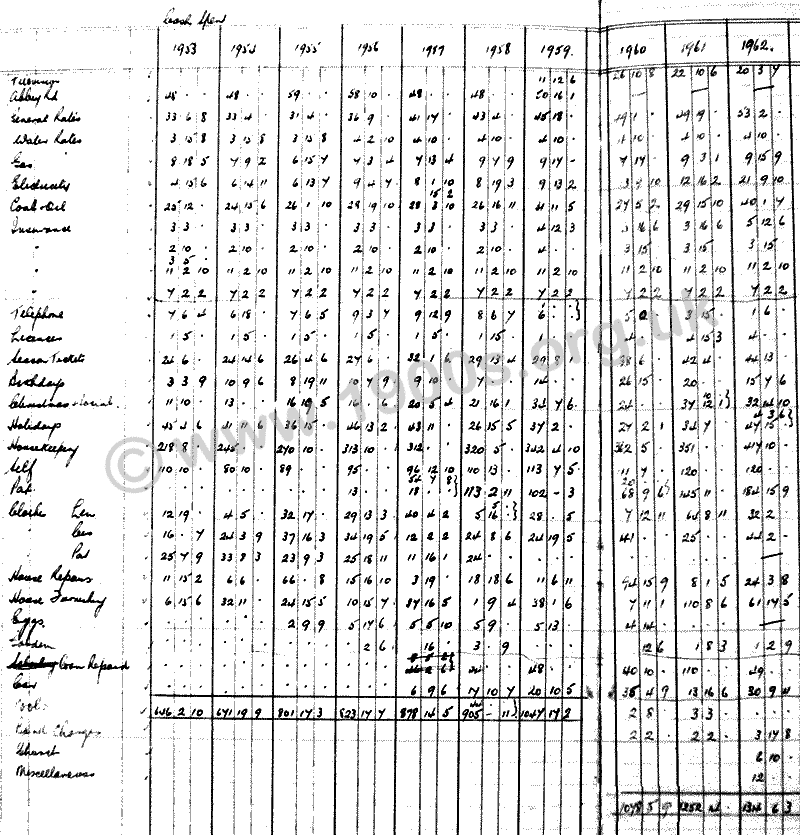
Thumbnail image of the yearly account book, years 1953 - 1962
Click the image for a larger version
At the end of every year, my father summarised the monthly outgoings for that year and entered them into a 'by-year' page at the end of his account book. The image shows a thumbnail for the page in the surviving account book, for the years 1953-1962.
The account book was lost to me for many years, but when I re-discovered it, I thought that the annual expenditures would provide a significant opportunity to investigate how the cost of living changed over the ten years and to work out a figure for inflation over that period.
In the first assumption, I was right, but the second proved very much less straightforward than I had thought.
The accounts as a basis for calculating inflation
It seemed self-evident to me that comparing the costs recorded in 1953 (from the household accounts page) with costs under the same headings in the 1962 column of the annual expenditures page - see the above image - would give good measures of inflation during that period.
How wrong I was!
Costs of common items in 1961
When I was a student at the University of Sheffield, I moved to Stephenson Hall in 1961. While there I kept detailed records of my finances. This included costs of common items.
James Baker
It was indeed straightforward to put expenditures in 1953 side-by-side with expenditures in 1962 and calculate how much more money my father needed or spent in 1962 compared with in 1953. However, as I looked down the list, I found myself realising that this figure could not be generalised for every other family because so many changes could be due to circumstances other than inflation. For example:
Mortgages. Repayments like those on our house remained constant throughout the lifetime of the mortgage because they had been set up on a fixed rate. So there was no change in the ten years, giving an apparent inflation of zero. Other otherwise similar families may have set their mortgage up at a different time at a different fixed rate or a variable one.
Wages and inflation
I was a wages clerk in the 1950s and when we made up the pay packets. The foremen, who often worked abroad, were paid a flat rate of £15.00 and they were the only ones who got the black and white five pound notes in their packets. I earned £7.50 per week and this was increased to £9.00 per week when I got married in 1955.
Eric Cowley
-
Heating expenses. In the early 1950s most people heated with coal fires, but from the late 1950s it became increasingly common for families to convert to central heating. Ours ran from oil, which was the cheapest fuel at that time, and then from gas after oil prices were increased fourfold.
-
Travel. My father changed his job during the ten year period and this necessitated different travel costs independent of the rate of inflation.
-
House repairs need attention intermittently and at haphazard rates. So there is no way of knowing how other families might be affected.
-
Furnishings costs and holiday costs are haphazard depending on whims, necessity and availability of money. In the early 1960s many families were taking advantage of the relatively new package holidays abroad and would have saved up for them.
-
Items like a car and a television were not parts of our lives in 1953.
These are just examples. My conclusion was that my father's account book could be used to calculate inflation of particular items of expenditure over specific but differing periods but that the time and effort required to tease out the appropriate data would be significant and probably not worth the effort.
Yet there were a few exceptions:
I saw no obvious reason why the costs of general rates (now council tax), water rates and electricity would have changed in our house any differently than in any other house, ie for any reason other than inflation. So they would serve to calculate the inflation under their headings for the ten year period of 1953 to 1962. The calculation is:
| category | cost in 1953 | cost in 1962 | inflation |
| general rates | £38-18-0 | £53-02-00 | 36% |
| water rates | £4-14-10 | £4-10-00 | -4% |
| electricity | £6-14-03 | £21-9-10 | 32% |
So the inflation for general rates and electricity bills in the ten year period of 1953-1962 were both over 30%. Somewhat surprisingly, though, the cost of water actually decreased slightly over the ten year period.
Also I felt that the inflation in housekeeping costs (ie for food and cleaning) should be generalisable across households, but it would need to be averaged out for a single adult individual. In 1953, there were three of us in my home: my father, my mother and me. I was 14 years old. So for the purposes of calculating housekeeping, I approximated to an adult, making three adults at home. By 1962 I had left home, so there were only two adults at home. Hence the following calculation.
| category | cost in 1953 | cost in 1962 | cost/ person in 1953 | cost/ person in 1962 | inflation |
| house-keeping | £219-16-00 | £218-08-00 | £219-16-00 _____ 3 |
£218-08-00 ____ 2 |
49% |
So, based on my father's figures, a reasonable estimate for the inflation in the costs of food and other household items between 1953 and 1962 was 49%. No wonder there were strikes for more pay!
Text and images are copyright

