













 Sainsburys
Co-op
Sainsburys
Co-opshops Payantake shops small family grocers greengrocers dairies
and milk
deliveries types of milk and milk bottles bakers sweet shops


Sainsburys grocery shops 1900-1950s
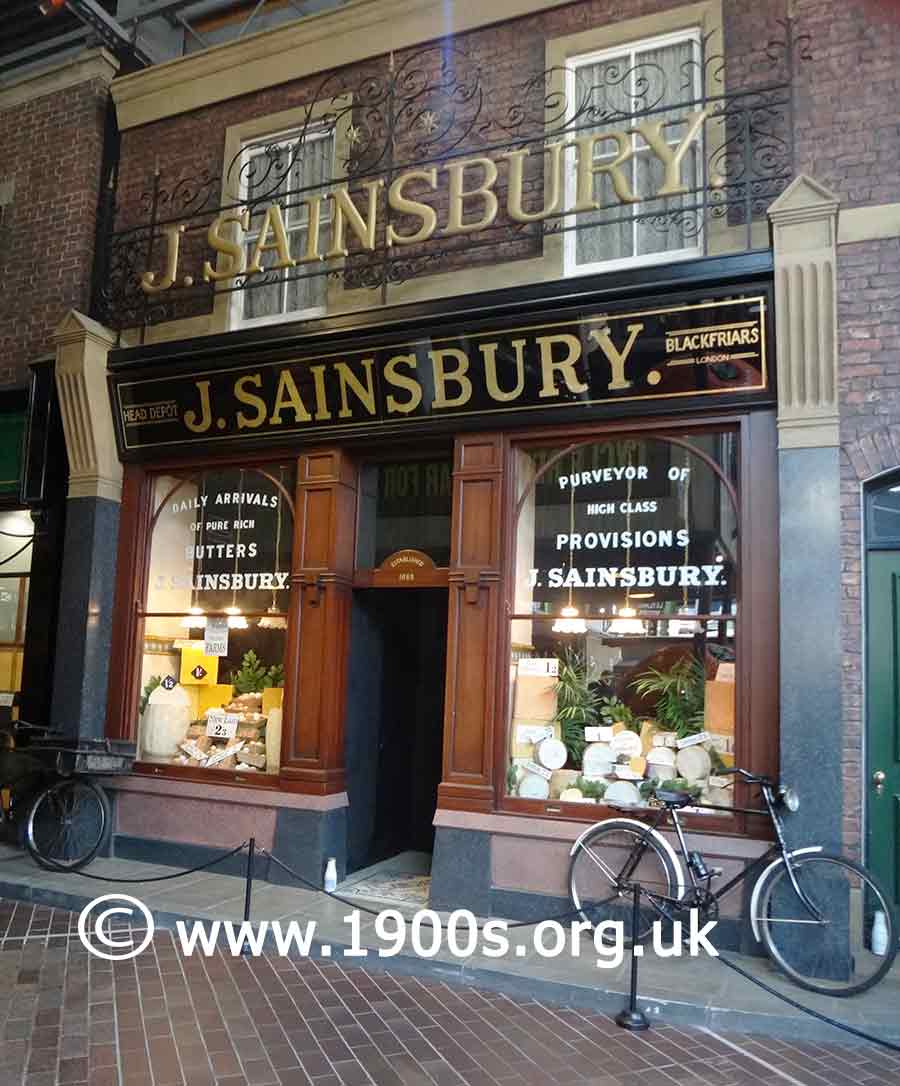
Life-size reconstruction of outside an old Sainsburys shop. Click/tap for a larger image.
There were several grocers when I was a child there in the 1940s. All were branches of chain stores, which is notable because chain stores had not yet come in for other types of shops. Some such shops may have had more than one branch, but not enough to be called chain stores. Sainsburys was one of the few grocery chain stores that still exist. Without the ropes, the first photo it would look just like the Sainsburys that I remember.
Why Sainsburys was so popular
My mother used Sainsburys more than any of the other grocers because she felt that the food was fresh, and she was registered there for our food rations. The place certainly looked fresh and clean.
Inside Sainsburys
The second photo gives a good idea of the layout and decor of Sainsburys in the 1940s and 50s as I remember them. The photo was actually taken in another town in 1906, so all Sainsburys were probably in the same style. In the 1940s and 50s, though, shortages and rationing were severe. Consequently a significant difference between the photo and my recollections of the 1940s and 50s is the amount and quality of the food on display. Another difference is that the photo shows gas lights hanging from the ceiling. In the Sainsburys of pre-war suburbia, the lights were electric.
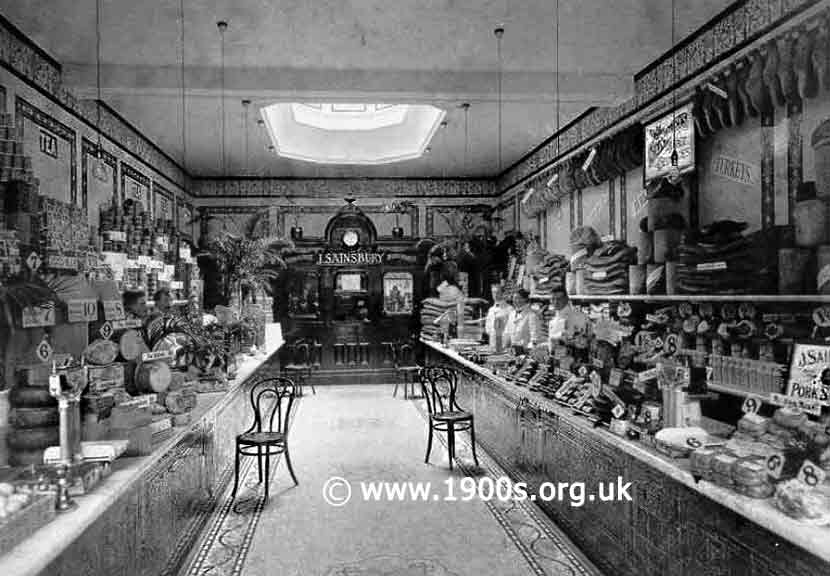
Although this photo was originally taken in the Guildford Sainsburys in 1906, it could easily have been the Sainsburys that I remember from the 1940s and 50s.
Click/tap for a larger image.
To me, as a child, walking into Sainsburys was like walking into a wonderland. It was a large shop, much deeper than it was wide, and every surface that could possibly be tiled, was tiled. The tiles were coloured mosaics with different patterns and inscriptions for the floors and walls; the counters were white marble; and the assistants all wore white. The whole impression was of lightness and cleanliness.
There was a single till with a cashier at the end of the shop inside a dark wooden carved cubicle and there were chairs beside the counters for the use of customers. Above the cashier's cubicle was the shop clock which was helpful for customers, very few of whom had watches.
What it was like to shop at Sainsburys
Different counters served different foods and each counter had its own queue. Queuing was a way of life that was accepted, even though grumbled about.
Although some goods were ready-packaged, so that the shop assistant at any one counter just had to reach for them, much of the fresh food was weighed out and packaged separately for each customer - which took a long time! During rationing, the pre-packaged goods were labelled National or Ministry of Food.
Customers paid at a single till at the far end of the shop, which meant that the assistants handling food never handled money - which was reasonable as so little was pre-wrapped.
Serving and packaging butter
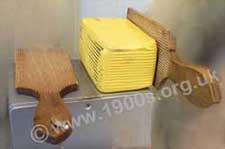
Model of wooden butter pats or paddles, showing how grocers used them to pat butter into the required size and shape for sale.
Publicity logos on the butter
Guest contribution
Our equivalent of Sainsbury's was David Greig whose company logo was a Scottish thistle. Each butter paddle was beautifully carved with a Scottish thistle in reverse so that the block of butter had the David Greig thistle logo embossed on it.
Jan Clifford
Butter was freshly patted out for each customer from a large block according to the amount they wanted. Then the freshly patted out block was placed on a sheet of greaseproof paper on a scale. If necessary, knobs of butter were added or taken off to achieve the requisite weight.
The wooden pats (also known as paddles) were dipped into a container water between uses to prevent sticking.
There was only one type of butter during rationing and it was labelled National Butter.
Serving and packaging tea
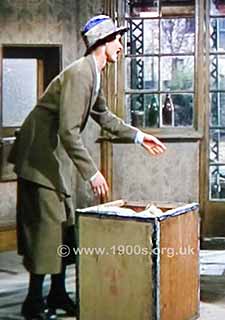
Woman unpacking from a tea chest. Detail from a screen shot from an old film.
Tea was loose in a big tea chest and was weighed out into a paper bag for each customer. During rationing it was one type, no choice.
Tea chests
Tea chests were large wooden boxes reinforced at the edges, usually with metal strips, and as their name implies, their purpose was for transporting and storing tea. In the 1940s and probably before, shops weighed out customers' tea directly from these tea chests and into paper bags. So, as tea was so widely drunk, there was no shortage tea chests and they tended to be regarded as throwaway items. Consequently tea chests were popular as storage and packing crates in homes and for moving house. Even as late as the 1960s, when my family moved house, the removal company brought along empty tea chests for us to pack into. Apparently it wasn't worth their while to bother to collect the empties afterwards.
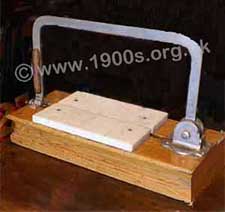
Grocer's cheese wire for cutting cheese.
Serving and packaging cheese
Cheese was in a large round lump and was cut with a wire. As far as I am aware, only Cheddar was available.
It was cut to size or weight with a cheese wire.
Serving and packaging sugar
Sugar was weighed out into a paper bag labelled National Sugar.
Serving and packaging bacon
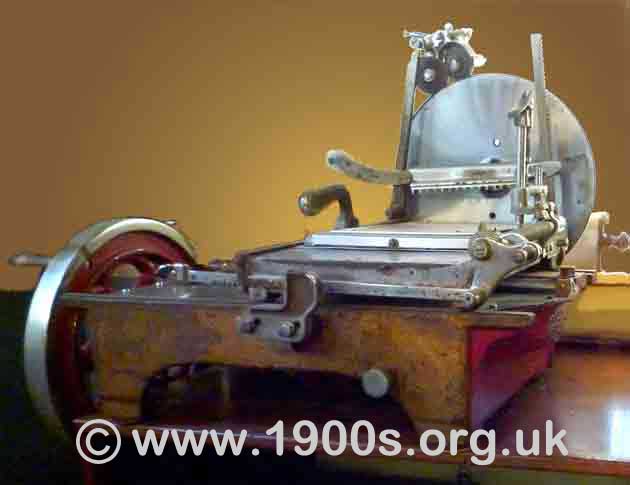
Old bacon slicer, photographed in the Museum of Nottingham Life.
Tap/click for a larger image.
Bacon slicers were on the counter to cut to order whatever thickness of bacon a customer wanted.
The cut bacon was wrapped in greaseproof paper and put into a paper bag.
If you can add anything to this page or provide a photo, I would be pleased if you would contact me.
Text and images are copyright
Photos taken by the webmaster with acknowledgments to Beaulieu Motor Museum, The Museum of Nottingham Life and Fagans Museum of Welsh Life

