













 writing paper and envelopes 1940s50s
holiday mail 1940s50s
economy mail 1940s50s
fountain
writing paper and envelopes 1940s50s
holiday mail 1940s50s
economy mail 1940s50s
fountainpens postage stamps
1900s-50s postage rates 1930-40s postal collections 1940s-50s postal deliveries 1900s-50s bureaus portable writing desks contents of writing desks 1930s50s


Contents of old writing desks
My grandfather's portable Victorian or Edwardian desk lay untouched from his death in 1940 to when I opened it to photograph it. Since he lived into old age, the contents of the desk must be little different from what they would have been in the early 20th century, in Victorian and Edwardian times and even before.
Sealing wax
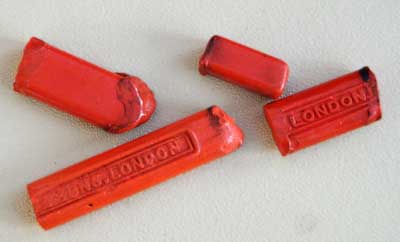
Sticks of partly-used sealing wax
Sticks of well-used sealing wax were in the bottom compartment of the desk.
The purpose of sealing wax was to show that any sealed document had not been tampered with between sending and arrival.
So sealing wax was used for important or private documents or valuable parcels.
How sealing wax was used
To use sealing wax, the sender put an end of the sealing wax strip into a flame to soften it and then daubed over the sealed or knotted part of the envelope or parcel. The sealing wax cooled rapidly making a surface that was so brittle that it chipped or broke easily. Consequently if anyone tried to tamper with the seal, the tampering was immediately obvious.
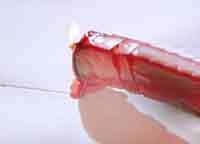
Hot, melted sealing wax being daubed into the sealed part of an envelope.
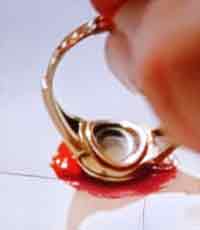
A ring with a 'seal' being pressed into sealing wax to replicate the design on the ring which was unique to the sender - usually initials or a crest.
Better-off people had a 'seal' which made a personalised impression in the hot wax, often initials or a coat of arms. It was often part of a finger ring. The likes of my grandfather, i.e. working class people, would not have owned such a thing.
In the 1940s my parents owned sealing wax. I only remember it being used once - and that stuck firmly in my memory because of how the sealing wax sparked while it was in the flame.
I clearly remember letters and parcels arriving with sealing wax on. Then it was mainly on the knot in string which tied parcels.
The pens
Guest contribution
Why my father used sealing wax
I can remember my father sealing a letter. He had an engraved signet ring and he explained that by pressing the ring into the still hot soft wax it showed it was he who had sealed the letter. No one else could tamper with it and reseal as only he had that ring.
Neil Cryer
The pens in the desk are best shown in photographs.
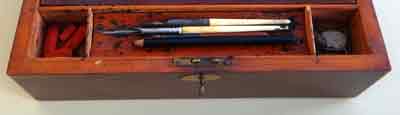
The pen compartment, with is original pens. The handles of two of the pens are bone, and the other is wood.

Pen with bone handle. Note how inky the handle is.
The pen nibs
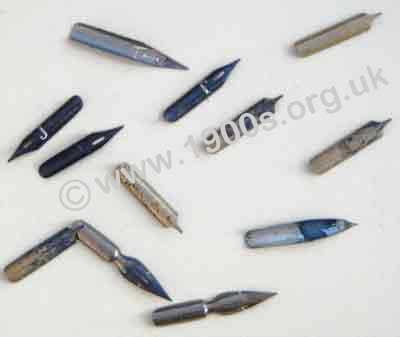
Nibs stored in the desk. Clearly these have been well-used, mainly with blue ink - presumably my grandfather's favourite colour.
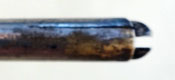
Enlargement of the nib housing. There are two concentric metal grips, the outer is slit so that it can be forced open.
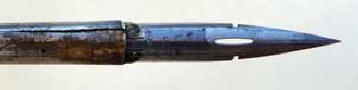
The nib in place, having been forced between the two grips and then held firm. When (not if) the nib breaks, it can be forcibly removed and replaced with a new nib
Miscallenea in the desk
Also found in the desk, which I have not photographed, are two well-used rubbers (erasers), paperclips, a pencil with a particularly thick lead and an unused 1939 diary.
If my grandfather had not been so ill when he died, the desk would probably have contained unanswered letters.
Text and images are copyright

