










 radios in WW2 and afterwards
radios for pop music in the 1950s
vintage
radios in WW2 and afterwards
radios for pop music in the 1950s
vintageradios gramophones and radiograms televisions
at home recording from television libraries
pre-digital lending in
libraries
pre-digital


How we used to listen to recorded music, mid-20th Century UK
In the early years of the mid-1900s, it was difficult for ordinary working class people to play the music they wanted without disturbing other members of the family. This was because there was only one radio in the household. Things began to change in the 1950s, but even then the internet and streaming music were unheard of.
Gramophones/record players
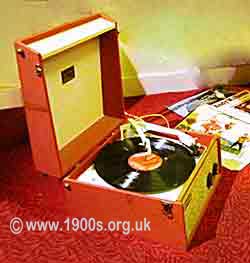
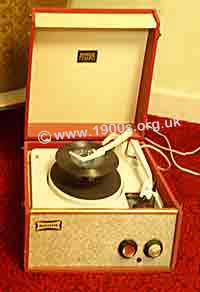
1950s record player. Photographed in Basingstoke Town Museum.
In my mid teens, which was in the 1950s, I managed to buy myself a record player. It was funded from a Saturday job working in the local department store in Edgware, Stanley J Lee.
Cheaper record players had by then come onto the market - or perhaps it was just one particular model which was cheap by the standards of the day. It was certainly mass-produced. (Record players, known by the older generation as gramophones, had existed in the better-off homes since before the war and can be seen in museums, but at the time I never knew any families that had one.)
I was very proud of my record player. It was housed in a large red and cream case with a latched lid and handle, clearly designed to appeal to teenagers. I was pleased to find an identical one in Basingstoke Town Museum - see the photo - and have seen others identical in museums since. Yet in spite of being advertised as portable, it was very heavy and I certainly never moved it far. In time I bought one of the new portable radios that were coming onto the market. It too was bulky and also in a red and cream box, with a lid that latched shut.
Wind-up gramophones
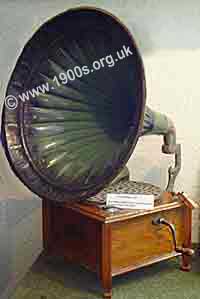
1920s or 1930s wind up gramophone with horn. Photographed in Nidderdale Museum.
Guest contribution
While I was growing up in the 1940s there was an old gramophone at home. We had to wind it up to make the turntable turn. The sound came out of a horn.
Neil Cryer
Gramophone records: 78s
Record players played from 'records' which were flat discs about 25 cm in diameter. One of these records was placed on the turntable of the record player, which rotated while a needle was allowed to glide over grooves in the record. This produced a sound which was amplified.
These early records - ie early from the point of view of being available to people who were not particularly well-off - were made of black Bakelite. They were damaged through repeated use, particularly if the needle was not changed frequently. They also scratched easily. If the needle jumped, which was not uncommon, the turntable swung it into the centre, making a bad scratch. When such a scratched record was played, the needle could bounce back every time it reached the scratch, making the same phrase repeat continuously until the needles was lifted over the scratch. At that time, people who kept repeated themselves were often described as sounding, "Like a broken record".
I saw many a scratched and shattered record. Nevertheless I did save up to buy a few, which were played repeatedly because they were all I had.
On one awful occasion my uncle and aunt brought their record player and some records to our home so that they and my parents could do ballroom dancing in our front room. My father hadn't any idea how to do it but shuffled game-fully around. In so doing, he trod on the pile of records which had been left on the floor by the record player. Every one cracked or broke into several pieces.
While these records were all we had, they were just known as 'records'. However, as improvements came along, they became known as '78s' because they played at 78 revolutions of the turntable per minute.
Guest contribution
You could 'play' old records by running your finger nail along a groove. Of course the resulting sound was very feint and the record got damaged in the process, but it was fun for a child to do when no adult was looking.
Neil Cryer
Gramophone records: 45's
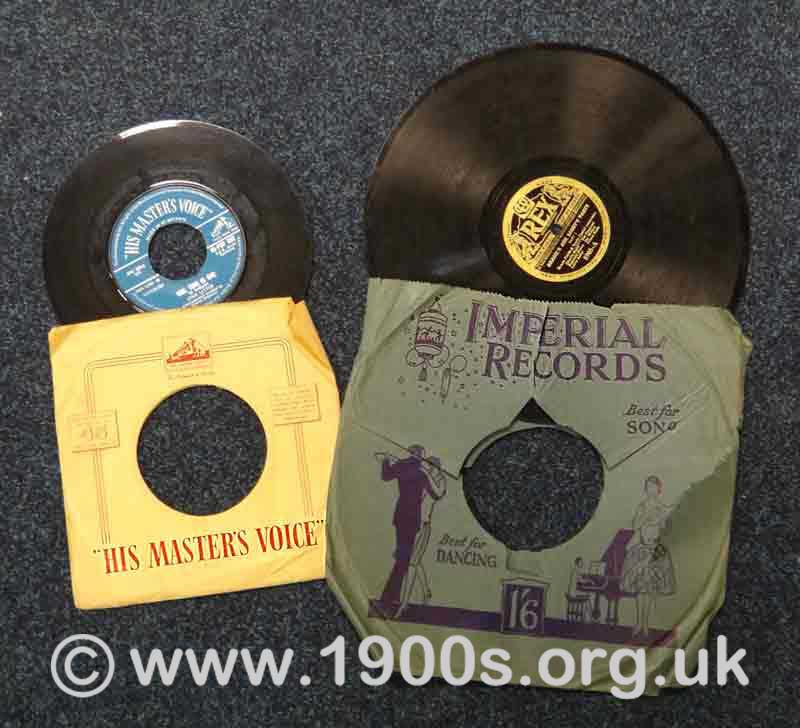
A 45 gramophone record on the left and a 78 record on the right.
Click for a larger image to see details of the labels and sleeves and the closer ridges on the 45 record.
Record player with an extended play facility. In practice there would have been several records on top of one another, ready to drop down and play.
Later records were an improvement over the 78s because they were smaller, were made of acrylic which was less brittle than the Bakelite of the 78s and played at 45 revolutions per minute. They were, not surprisingly, known as 45s, but they were also known as 'extended play' because the slower speed meant that more music could be fitted on.
Another advantage of the 45s records was that, being less brittle, there could be a facility for them to be dropped onto the turntable, one at a time from a small pile each time the previous record finished. This enabled the music to last for some considerable time without anything having to be reset.
There was a switch on the 'then-modern' record players to allow playing at either 78 or 45 revolutions per minute.
Radiograms
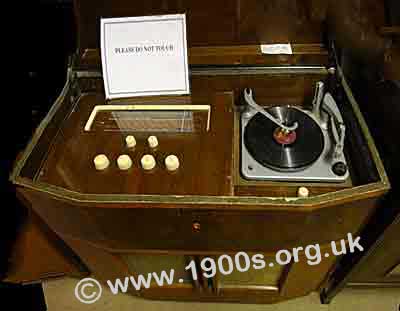
Radiogram with lid open to show the radio and the gramophone.
In the better-off households there were radiograms which were bulky comprising a radio, a record player/gramophone, speaker and storage shelves in one large polished dark-wood cabinet.
Radiograms were items of furniture, not unlike the early televisions in that they were also housed in large polished dark wood cabinets.