














 Anderson
air raid shelters Morrison
air raid shelters public
air raid shelters school
air raid shelters London underground shelters anywhere suitable for shelters


Morrison air raid shelters in 1940s war-time Britain
Why choose a Morrison shelter?
Morrison shelters were for indoors. They took up a lot of space in a room and made the room look untidy, even though they could double as a table in daytime.
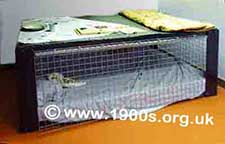
Morrison shelter - the view that an adult sees, looking down on the shelter, the top of which was used as a table.
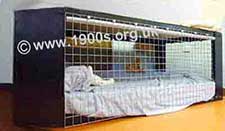
Morrison shelter - all I ever saw of it as a young child in the blitz of World War Two, not tall enough to see over it.*
So people with large families tended to choose an outside Anderson shelter for air raid protection in the Second World War, rather than having to have more than one Morrison shelter indoors.
Morrison shelters were relatively quick to get to when there was an air raid, and they were also warmer than Anderson shelters because they were indoors. Many a tme I slept in one.
The location of a Morrison shelter
Guest contribution
Morrison shelters were always downstairs, because the lower floor was stronger than the upper ones. If the house collapsed, the shelter wouldn't fall with it and would be better able to stand the shock.
Tony Shepherd
My parents had our shelter in the sitting room, i.e. the front downstairs room of our house. Only much later did I learn that it was called a Morrison shelter, as my mother just called it 'the shelter'.
Description of a Morrison shelter
As I was born in 1939, I was too small to see over the top of our Morrison shelter, and to me it was like a four poster bed with no legs, resting on the floor.
The tops of Morrison shelters were used as tables, but by the time I was big enough to see over the top of one, the war was over and our downstairs front room had returned to normal.
Guest contribution
Our Morrison shelter gave us a great surface for playing ping pong on.
Tony Shepherd
Setting up a Morrison shelter
Guest contribution
My father set up our Morrison shelter in our dining room. He first erected the steel girder framework and then bolted down a huge sheet of discoloured steel as the 'lid'. The frame was surrounded by wire mesh, held in place with sprung hooks on each corner.
Richard Ouston
The dash to the Morrison shelter when the siren announced an air raid
Whenever the air raid siren sounded, announcing the coming of an air raid, my mother would pick me up from my bed and deposit me in the Morrison shelter.
Then she would try to get her own mother who was living with us. That took time and effort. My mother would be screaming at her to come on and she would announce ponderously, "All right, all right, I'm coming". She was old, widowed and fed up with life, and I realise now that she probably didn't care very much whether a bomb hit us or not.
Inside a Morrison shelter
Our Morrison shelter had to sleep me, my mother and my grandmother. My father of course wasn't there. It was a tight fit, even though it was officially a double version. Incidentally I have only ever seen single ones since in museums.
The Morrison shelter contained a large mattress of sorts, sheets, blankets and pillows - all used for sleeping during the night-time air-raids.
During the latter years of the war, I was still up in the early evenings, and with my young ears I often heard the wail of a distant siren before my mother did. I always told her because it was fun to go into the shelter. It must have been awful for her, though, tired out at the end of a long day, having to organise her mother and me, and of course losing sleep in the process.
Claustrophobia and excessive heat
Guest contribution
It was claustrophobic in the Morrison shelter with the four of us lying close together with barely room to turn over. It made body heat a problem too. However families who had the outdoor Anderson shelters were cold and damp. At least we were indoors and dry, even if we were over heated!
Richard Ouston
If you can add anything to this page or provide a photo, I would be pleased if you would contact me.
*Photographed by the webmaster in Lincolnsfields Children's Centre, Bushey
Text and images are copyright

